Tuesday Pizza Party: Work Perks, Culture, and the Future of the Workplace
I was talking to a friend recently about a potential job move, and inevitably the conversation turned to what they’d be leaving behind. Not the work itself, but the perks: free drinks and snacks, pizza parties, bi-weekly socials, branded hoodies and baseball caps. It sounded less like a workplace and more like a well-funded student society. Honestly, I was blown away – why leave somewhere that seemed to care so much about employee happiness?
But then it got me thinking. These kinds of perks feel distinctly modern. I can’t recall my parents or grandparents describing anything similar. Certainly nothing beyond the occasional long-service clock or retirement gift. So when did this shift happen? Are workplace perks genuine forms of support, or carefully designed tools? Do they empower workers, or subtly reshape how control operates? And perhaps more importantly, what kind of future of work are they building, and for whose benefit?
This blog post aims to take a cultural-historical look at why things like free food, slides, and flexible hours feel revolutionary, and what they are really doing. Drawing from psychology, design, economics, sociology, to explore how work has shifted, and where it might be heading.
From the rigidity of the Fordist factory bells to the fluidity of nap pods and kombucha taps, the evolution of the workplace reflects deeper transformations in how we as a society conceptualise productivity, autonomy, identity and control. The modern workplace has evolved alongside deeper shifts in how we understand productivity, autonomy, identity and control. Increasingly, the workplace now resembles more a lifestyle brand rather than a purely functional site of labour, and perhaps…that’s the problem?
A Brief Cultural History of the Workplace
To understand today’s workplace perks, it’s worth starting from a time when they barely existed at all.
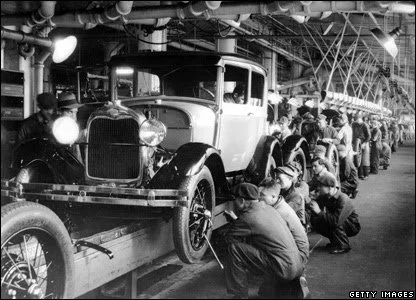
In the late 19th century, work was shaped by the logic of ‘Taylorism’, or ‘Scientific Management’, developed by Frederick Winslow Taylor. His aim was to make labour as efficient as possible by breaking it down into measurable, controllable tasks. Even elements we might now recognise as early ‘benefits’: structured training, pay scales, even rest breaks, were introduced with this goal in mind. Rest wasn’t about wellbeing so much as the output; a rested worker, after all, is a more productive one. These early ‘perks’ were therefore all in the pursuit of economic efficiency, not genuine care for the workers.
This logic set the precedent for much of the 20th century and intensified with the rise of ‘Fordism’. Henry Ford’s assembly line revolutionised production but it also reshaped the relationship between worker and employer. Higher wages and the five-day, forty-hour working week were introduced, but again, not purely out of goodwill. They were strategic responses to absenteeism and high labour turnover, designed to create a stable, disciplined workforce. Crucially, they also enabled workers to afford the very products they were making, tying mass production directly to mass consumption. Workers were paid more, but in part so they could purchase the latest consumer goods rolling off the production line.
Before this, in the pre-welfare industrial period, there were no formal perks to speak of. Work was fundamentally about survival and a payslip. Any form of care existed outside the workplace, largely within the domestic sphere: meals prepared at home, family support networks, and community ties that sustained workers between shifts. Factories offered little in the way of provision; workers brought what they needed, and the boundary between labour and life was clear.
There was, however, something appealing about this separation. Work was work, and care belonged firmly to the home. I often think of my grandmother preparing my grandfather’s lunch for the next day; something so simple, yet deeply kind. It wasn’t strictly part of this pre-welfare era, of course, but it captures the same feeling. Care existed, just not within the structure of work itself. There was an understanding that support came from family, community and home, rather than from an employer.
That is not to say work and social life were completely separate. Some of the earliest examples of these boundaries softening came from workers themselves rather than management. Football clubs, for example, emerged as ways to socialise, exercise and unwind after long shifts. The club that would eventually become Manchester United was formed in 1878 by employees of the Lancashire and Yorkshire Railway depot. Arsenal emerged in 1886 from workers at the Royal Arsenal armaments factory in Woolwich, while Motherwell was formed the same year through a merger of local factory teams, including one from the Alpha Steam Crane and Boiler Works.
But this was about as far as the overlap extended. The workplace might help you make friends, but those relationships were largely carried into life beyond the factory gates. Care remained external to work, and employers had yet to make it part of the employment relationship itself.
It's only after the Second World War that we begin to see something more recognisable emerge in the form of corporate paternalism. Employers started providing housing, healthcare, cafeterias and recreational facilities. Once again, these benefits were not purely acts of benevolence, but part of a broader strategy. They helped reduce turnover, increase productivity, and, crucially, foster loyalty. Workers were no longer just employees; they became members of a managed community, often tied to their employer both economically and socially.
This period saw the rise of company-sponsored social clubs, long-service awards, family event and organised outings. Employers increasingly offered benefits designed to create what they saw as the ideal worker: pensions, educational opportunities for employees’ children, subsidised leisure activities and greater economic security. Work was no longer confined to the factory floor or office; it began extending into family life, recreation and community.
Of course, these benefits came with expectations. In exchange for security and stability, workers were expected to offer loyalty and, often, to avoid collective resistance such as unionisation. There was also a practical dimension to this arrangement. The more your housing, healthcare and social life depended on your employer, the harder it became to leave. During the hire-purchase boom of the 1950s, when many families were taking on debt to furnish their homes with modern consumer goods, stable employment became even more important. If the repayments depended on your wage packet arriving every week, walking away from your job became a far riskier decision.
It is important, however, not to confuse these employer-provided benefits with workers’ rights. Throughout the 20th century, organised labour movements and trade unions fought for structural protections such as regulated working hours, paid leave, maternity rights and workplace safety standards. These were not perks handed down by employers; they were hard-won protections secured through political pressure, negotiation and often industrial action.
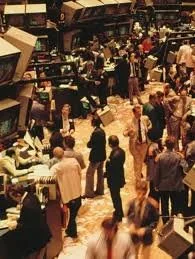
By the late 20th century, another transformation was underway. The paternalistic model, built around long-term employment and mutual loyalty, began to give way to something new. If the post-war workplace said “work is everything because we’re trying to keep you,” the emerging neoliberal workplace increasingly suggested “work is everything because you’re trying to keep the job.”
Benefits were no longer framed as rewards for decades of service but as features of a desirable workplace culture. The goal was no longer with one employer for life; it was to remain competitive, adaptable and employable. Work became less about what you did and more about who you were. Professional success increasingly formed part of personal identity. What makes this period particularly interesting is the coexistence of two seemingly contradictory attitudes towards work. On one hand, popular culture celebrated the hyper-ambitious professional – Wolf of Wall Street, American Psycho and Jerry Maguire, where long hours, wealth and career advancement became markers of personal worth. On the other hand, the outward appearance of work became noticeably more relaxed. Open-plan offices replaced executive offices, trainers appeared alongside business attire and hierarchies became less visible, even if they remained firmly in place.
Historian Fred Turner argues that many of these changes can be traced back to the influence of the 1960s Californian counterculture on the emerging technology sector. Values such as anti-authoritarianism, personal liberation and scepticism toward bureaucracy were gradually absorbed into Silicon Valley’s corporate identity. This created a fascinating paradox: technology companies presented themselves as culturally rebellious while becoming some of the most powerful economic institutions in the world.
Steve Jobs’ trademark combination of jeans and a black poloneck captured this perfectly. It was a statement that signalled a rejection of the traditional corporation with its suits, formal titles and rigid hierarchies. The message was clear: this wasn’t your father’s company. They were something new. Yet despite the casual dress and informal culture, these organisations remained highly structured and intensely profit-driven.
The result was a new neoliberal workplace model in which the boundaries between labour and leisure became increasingly blurred. As unions declined, workers changed jobs more frequently than previous generations and new industries emerged, employment became less a place you went and more a lifestyle you inhabited. The modern workplace was no longer simply providing a wage; it was offering an identity, a community and increasingly, a way of life.
So now we’re caught up, let’s look at the workplace perk that started this whole post.
Free Food, Pizza Parties & the Illusion of Generosity
Most of us have experienced a period of low workplace morale where management, in an attempt to fix things, wheels out a strange midday pizza party. Although perhaps novel in the early 2000s, the pizza party has now become something of a caricature, often lowering moral rather than raising it. So why, when I first watched The Internship with Owen Wilson and Vince Vaughn, was I completely blown away by the endless free food options available at the Googleplex? Isn’t it essentially the same thing?
Well, not quite.
The phenomenon of free food at work, particularly common in tech companies and high-pressure urban firms, draws on several intersecting ideas from psychology, behavioural economics and workplace sociology. In both cases, free food is not simply an act of generosity, but a highly strategic tool shaping worker time, behaviour and loyalty.
But how do companies afford all of this?
Part of the answer lies in a psychological concept known as hedonic adaptation. This describes our tendency to quickly normalise pleasures and privileges that initially feel exciting. (Similar to how lottery winners quickly run out of money when they adjust to their new means!) New employees might spend their first few weeks enthusiastically sampling everything on offer, but by week 3 or 4 most people regulate, they return to baseline behaviour and no longer binge on a previous novelty. The free buffet becomes normal. Appreciated certainly, but no longer exploited.
There’s also an element of diminishing marginal utility at work. Put simply, each additional benefit delivers less value to the consumer over time. This predictability allows companies to monitor usage patterns and allocate supply accordingly. If employees stop reaching for burgers every January because they’re attempting a post-Christmas health kick, the company can simply adjust supply. Food waste, consumption patterns and seasonal preferences are all tracked and analysed. Add in economies of scale – feeding thousands of employees from centralised food stations – and the costs become surprisingly manageable.
However the real value for employers isn’t the food itself.
Providing meals within the workplace anchors people physically to the office. For example, an employee who would normally leave the building for lunch might stay on site instead. Someone else might remain 30-60 minutes longer because dinner is available downstairs. Over weeks, months and years, that adds up to a significant return on investment for the company. More importantly, lunch stops becoming a genuine break. People eat at their desks, discuss projects over meals – basically remain psychologically connected to work even when they’re supposed to be resting.
This brings us to two of the most important ideas underpinning workplace perks.
The first is social exchange theory. Just like the gifts, outings and long-service awards of the post-war period, free food encourages the basic human principle of reciprocity. When a company appears to give employees something extra, people often feel a subconscious obligation to give something back, whether that be loyalty, gratitude, flexibility or simply a willingness to go the extra mile.
The second is cognitive fluency, which is the ease with which the brain processes everyday decisions. It’s the same logic often used to explain why Barack Obama limited his wardrobe choices or why Steve Jobs wore essentially the same outfit every day. When employees don’t need to plan lunch, decision fatigue is reduced and they conserve mental energy for work tasks. Workers are not only physically remaining in the workspace; they are psychologically remaining there too. In Foucauldian terms, this becomes a subtle form of spatial control and biopolitical management. Behaviour is shaped without workers necessarily feeling controlled at all.
That said, it would be unfair to ignore the genuine benefits. Shared meals foster informal social bonds, and the aesthetics of abundance and generosity can do wonders for workplace identity. Eating has always been a fundamentally social activity, and communal cafeterias create opportunities for interaction that might not otherwise occur. This is where the idea of the third space becomes useful: a social environment that is neither home nor formal workspace but a relaxed social space in between. Cafeterias, coffee bars and breakout areas can function as these kinds of spaces, encouraging conversation and community.
The difference between the pizza party and the Googleplex cafeteria ultimately comes down to narrative and branding.
A pizza party often feels like a temporary solution to a deeper problem. It creates a sense of scarcity because it arrives as a special event. It’s not the norm. Google’s food offering, by contrast, is built into the infrastructure itself. Free food sits alongside desks, meeting rooms and Wi-Fi as a permanent feature of the workspace. The messaging is subtly different. They’re saying “We’ve designed this whole experience FOR you, not because we’re trying to make up for something”. Employees choose from dozens of options and customise their meals. In doing so, they experience a sense of agency and abundance that becomes closely tied to the company’s identity – it’s part of the Google lifestyle.
Ultimately, free food, like many workplace perks, creates a powerful illusion of culture and care. Sometimes that care is genuine. Sometimes it compensates for things that employees might value more, such as higher pay, greater autonomy or flexible working arrangements. It simulates the feeling of being a valued employee through material means but doesn’t necessarily address long-term wellbeing. Perhaps most importantly, perks create a sense of loss aversion. Once people become accustomed to free meals, free coffee or on-site services, giving them up feels like a sacrifice.
So What…
Are all workplace perks shallow? Are they simply tools of control? And why should we care?
I’ll be honest, it doesn’t always look great.
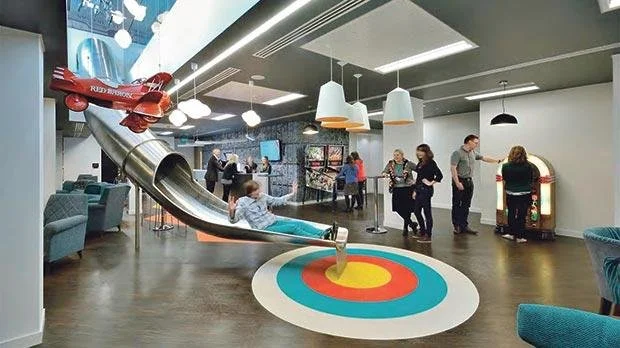
Any form of corporate infantilisation - the Google slide, ball pits, game rooms – can dangerously blur the boundary between work and play. On the surface, these spaces signal creativity, freedom and a rejection of hierarchy. Yet they often exist within highly structured and carefully managed environments. Sociologist Erving Goffmann would likely have had a field day with them. The logic behind these perks is not actually that different from Taylor’s rest breaks over a century ago: if workers are given time to play, they’ll work even harder when they return.
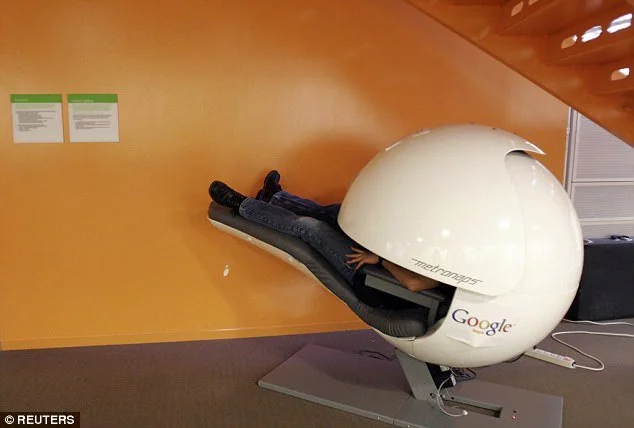
The same questions can be asked of nap pods, wellness rooms, lunchtime yoga sessions and workplace mindfulness apps. They may seem entirely positive on the surface, but at what point does employment become too involved in our personal lives?
Foucault would probably describe many of these initiatives as forms of biopolitical control, and it’s not difficult to see why. Companies have a vested interest in managing employee health because healthier employees are generally more productive employees. The challenge is that the line between genuine care and productivity engineering can be incredibly difficult to spot. Take nap pods as an example. They don’t address the cause of exhaustion or overwork; they simply provide a mechanism for managing it. The same can be said for lunchtime yoga classes aimed at reducing workplace stress. In both cases, wellness becomes something to be optimised in service of work, rather than an end in itself.
Some modern workplace benefits are therefore presented as progress while ultimately serving institutional goals. In certain cases, they’ve even contributed to burnout culture. Communication platforms such as Teams and Slack have helped create an “always on” working environment where the boundaries between work and personal life become increasingly blurred. Even seemingly trivial things take on significance: keeping your Teams status permanently green, choosing the right emoji reaction or finding the perfect GIF can become a strange form of emotional labour. Workplace culture no longer ends when you leave the office; it follows you home in your pocket.
Of course, it’s not all negative.
The COVID-19 pandemic fundamentally shifted expectations around work and accelerated the adoption of flexible hours, hybrid working and remote employment. For many people, this has meant greater autonomy and a healthier work-life balance. In these cases, workplace change has genuinely expanded freedom rather than restricted it. Models such as Denmark’s trust-based approach to work, or Iceland’s experiments with shorter working weeks, suggest that productivity and employee wellbeing do not necessarily have to be competing priorities.
What could work look like in the future?
The question then becomes: where does all of this lead?
If workplace perks have evolved from Taylor’s rest breaks, to Ford’s higher wages, to Google’s free food and wellness programmes, then what might the next stage look like? Looking at current trends, we can already start to see some possible futures emerging.
Some speculative futures could include:
Biophilic office design, where workplaces incorporate nature and green spaces directly into the working environment, such as Amazon’s Spheres in Seattle.
Neurodiverse and adaptive workplaces, designed around different sensory and cognitive needs rather than assuming one way of working suits everyone. Microsoft’s neurodivergent hiring programmes offer a glimpse into this approach.
Biometric-responsive offices, where lighting, temperature, seating or even workloads adjust based on data gathered from wearable technologies such as Oura Rings or Fitbits.
Mobile offices and digital nomadism, building on trends we already see today through work pods, co-working spaces and nomad visa programmes in countries such as Estonia and Portugal.
XR and Metaverse Workplaces, where virtual and augmented reality become integrated into everyday working life. We have already seen early experiments through Meta’s Horizon Workrooms and Microsoft’s Mesh platform.
Whether any of these become mainstream remains to be seen. What is certain, however, is that the workplace will continue to evolve alongside changing technologies, social values and economic priorities. The same questions that surrounded company housing, workplace cafeterias and wellness programmes will likely follow these innovations too: who benefits, who controls them and what are they actually designed to achieve?
Conclusion
So, as we hurtle into the future of work, it is important to keep one eye firmly on the past.
The workplace is not simply somewhere we earn a living. It is a cultural, psychological and political space; one that increasingly functions as a lifestyle as much as a job. It can be a source of community, identity and wellbeing, but it can also operate as a subtle system of control.
Perhaps the most important thing this history shows is that workplace perks are nothing new. From Taylor’s rest breaks to Ford’s higher wages, from company picnics to free sushi and nap pods, perks have always reflected deeper questions about labour, time, care and power. Some provide genuine benefits. Others are largely symbolic. Many sit somewhere in between.
A 2015 Glassdoor survey found that workplace perks were a major factor in job choice for many employees, particularly younger workers. Yet satisfaction with perks does not necessarily translate into greater autonomy, better working conditions or even higher productivity. There is often a gap between the intended, perceived and actual effects of these benefits.
Understanding that history does not mean rejecting workplace perks altogether. Free food, flexible working and wellbeing initiatives can make people’s lives genuinely better. Rather, we the public must be mindful of the reasoning behind these perks and approach them critically. Every perk tells us something about how a company understands work, what it values, and what it expects in return.
So, the next time you’re offered a pizza party, wellness app discount code, or a beanbag-filled breakout room, it might be worth asking a simply question: is this a benefit, a tool of control or – as history suggests – both at the same time?
Love this topic and want to explore more?
Things to look up:
· Japanese Karoshi (death by overwork) and work culture obsession
· Sherry Turkle’s work on tech and mediated communication
· Gitlab – async first global model
· Frank Lloyd Wright’s organic architecture
· Wendy Brown’s views on neoliberal autonomy vs real freedom
Watch:
· Severance (2022)
· Sorry to Bother You (2018)
· The Office (2001 and 2005)
· The Good Place (2016)
· The Internship (2013)
· The Pod Generation (2023)
Read:
· American Technological Sublime by David Nye
· The Age of Surveillance Capitalism by Shoshana Zuboff
· Discipline and Punishment by Michel Foucault
· The Conquest of Cool by Thomas Frank
· The Nowhere Office by Julia Hobsbawm
· Bullsh*t Jobs by David Graeber
Bonus Question to Think About!
If AI reduces the need for human labour, will future workplace perks be designed to make us more productive, or simply to make us want to stay?