As I was wading through Instagram the other day, I came across a post that read: “And just like that, the age of photographic evidence is over. 1826-2025. Update your epistemology accordingly.” It accompanied an image generated by the AI model Nano Banana Pro.
It got me thinking. The year 1826 is an interesting choice. It marks the moment when the French inventor Nicéphore Niépce produced the world's earliest surviving camera photograph, taken from a window at Le Gras. This moment is often described as the birth of photography.
The post frames the period between 1826 and 2025 as a kind of “age of truth,” implying that photographs could be treated as reliable evidence until the supposedly apocalyptic arrival of AI-generated images. The suggestion is clear: once artificial intelligence can fabricate convincing picture, our ability to distinguish truth from invention collapses.
As a historian, I find this assumption rather amusing. It presumes that before 2025 humans had never been deceived, or attempted to deceive, through images. In an era of voice-cloned politicians and hyper-real video hoaxes, it is tempting to see deepfakes and AI-generated media as uniquely modern threats. Yet every era has possessed it’s own tools for misleading the public.
Long before artificial intelligence could produce viral clips of Will Smith eating spaghetti, artists, conmen and propagandists manipulated images by hand. In many ways, the impulse to visually distort reality is as old as the human desire to control a narrative – long predating 1826.
What often goes overlooked, however, is the role of the audience. Visual deception throughout history didn’t succeed because people were naïve or unthinking. Rather, it succeeded because each manipulation was calibrated to what its audience was prepared to see, or wanted to believe. Consider the viral videos of animals spontaneously breakdancing: we immediately recognise them as AI-generated. But an image of two best friends holding hands appears far more plausible, simply because we are not primed to question it. The difference lies less in technical sophistication than in expectation. Whether it was a “spirit” captured on camera or a retouched photograph preserved in a Soviet archive, such images worked because they operated within a particular cultural and psychological context.
To illustrate this point, it is worth looking at several examples. Although the tools of deception have changed, the impulse to manipulate what people see is anything but new. This post argues that audiences have never been passive victims of visual fraud. Instead, they have always been active participants in the ongoing contest between illusion and truth.
For that reason, we should not be overly anxious about suddenly losing the ability to tell reality from AI. What we now call “deepfakery” is simply the latest technological iteration of much older strategies of image control. Understanding that history may prove to be our best defence against the next generation of forgeries.
Abraham Lincoln’s ‘Facetuning’
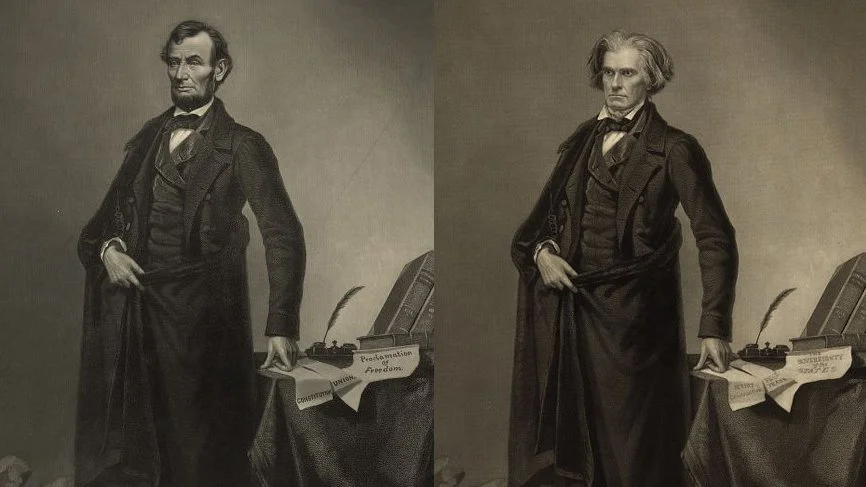
“Photography lost its innocence many years ago." (Professor Hany Farid, University of California, Berkeley)
One of the most famous portraits of Abraham Lincoln, widely reproduced in textbooks and media, is in fact a striking example of early photographic manipulation. In this case, however, the editing was not intended to narrow a nose or widen hips. Instead, it solved a far more practical problem: Lincoln was already dead.
The photograph most people recognise was taken in February 1864 by Anthony Berger, the head photographer at a Washington DC studio run by Mathew Brady. Brady was one of the earliest photojournalists in the US, and gained prominence for his photographs of Civil War battlefields.
Berger’s portrait quickly became iconic. It was widely circulated and eventually served as the basis for the engraving of Lincoln used on the five-dollar bill between 1914 and 2007.
After Lincoln’s assassination in 1865, however, public demand for heroic images of the fallen president grew dramatically. The difficulty, of course, was that no new photographs could be taken. To solve this problem, printmaker William Pate produced a composite image: he flipped and superimposed Lincoln’s head onto an 1852 engraving of the Southern politician John C. Calhoun.
The edit did not stop there. The papers on the table in the original Calhoun engraving, labelled ‘Strict Constitution,’ ‘Free Trade,’ and ‘The Sovereignty of the States’ were altered to read ‘Constitution,’ ‘Union,’ and ‘Proclamation of Freedom.’ The irony is striking, given that Calhoun had been one of the most prominent defenders of slavery.
According to Professor Farid, the alteration likely occurred because there was no sufficiently ‘heroic-style’ portrait of Lincoln available. The resulting image, now commonly known as the ‘Calhoun-Lincoln Composite,’ circulated widely without it’s true origins being recognised.
Remarkably, the composite nature of the image went largely unnoticed for decades. Historian Harold Holzer suggests that the first person to identify the manipulation was Library of Congress archivist Milton Kaplan in a 1970 article titled Heads of State.
Click here for more information on this example
Stalin’s Use of ‘Generative Background Fill’
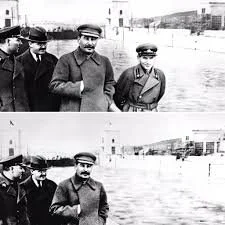
Under the regime of Joseph Stalin, photography became a powerful instrument of political repression. Images were routinely altered to remove purged individuals, effectively rewriting the visual record of history to match the prevailing political narrative. So just remember that the next time you remove strangers from the background of a holiday photo, you are participating (albeit harmlessly!) in a technique with a far darker past!
One of the most famous examples involves Nikolai Yezhov, head of the NKVD (the Soviet secret police) during the Great Purge. In a widely circulated photograph from 1937, Yezhov is seen walking beside Stalin along the Moscow-Volga Canal. After Yazhov’s execution in 1940, however, he was meticulously removed from the image. The background was carefully retouched so that no trace of his presence remained.
This practice extended to numerous other figures who later fell victim to the regime, including Leon Trotsky, Grigory Zinoviev, and Lev Kamenev. They were systematically removed not only from photographs but also from official documents and publications. Such alterations were not simply about controlling the present; they were also about shaping collective memory. By eliminating visual evidence of certain individuals, the regime sought to erase alternative narratives from history itself.
As scholars such as David King have demonstrated, these photographic manipulations played a central role in reinforcing Stalin’s cult of personality , presenting him as the unchallenged architect of Soviet progress.
For more information on this example, check out David King’s book ‘The Commissar Vanishes’.
Was it only photographs that were manipulated? Of course not. The distortion of information and sources has been a recurring feature of history, particularly throughout the twentieth century. Consider researching, for instance, the controversy surrounding the Zinoviev Letter – a document published in 1924 that was later widely regarded as a forgery used to influence British politics. A bit like a political ‘Mean-Girls’ Burn Book.
Even seemingly objective tools such as maps are not immune. The Mercator Projection, first introduced in 1569, was designed as a navigational aid but dramatically distorted the relative size of landmasses. The result was a map that appeared authoritative and accurate, yet subtly reshaped viewers’ perceptions of the world.
Sharper Fakes for Sharper Eyes
Deepfakes aren’t anything new. What is new is the audience it must now deceive. As a species, we have evolved alongside our visual media. Today’s deepfakes aren’t more alarming because they’re ‘flawless’ as the Instagram post suggested; rather, they are more sophisticated because humans have become harder to fool. After decades immersed in visual culture such as cinema, television and social media, we’ve developed sharper eyes and stronger sceptical instincts.
Consider the evolution of special effects in film. Horror movies from the 1950s and 1960s once terrified audiences, yet modern viewers often watch them and laugh, their monsters and practical effects now appearing charmingly artificial. What once convinced us no longer does.
Over time, audiences have developed greater visual literacy, a heightened scepticism, and far more media experience. Returning to the cinema for a moment, consider the early days of CGI. When digital effects first become common, their artificiality was often obvious, think of the Scorpion King in The Mummy Returns (2001) or the notorious Tsunami-surfing sequence in Die Another Day (2002). The digital creatures and environments clearly stood apart from the real footage.
Today, CGI is vastly more sophisticated, yet audiences still sense when something is not quite right. Many fans of Marvel, for instance, have noted that Iron Man’s later CGI suits sometimes appear less convincing than the practical props used in the first Iron Man.
Greater realism has not made us more gullible; if anything, it has made us more discerning. We have learned to recognise subtle visual cues that suggest something has been altered, even when the illusion appears nearly perfect. Online, countless videos show viewers quickly spotting AI-generated footage by noticing warped objects, illegible background text, strange ‘static’, or unnatural movement.
Psychologists often explain this reaction through the concept of the ‘Uncanny Valley’. Humans tend to feel unease when confronted something that appears almost, but not quite, real. Even the most convincing deepfakes can trigger this subtle discomfort. The problem is not always that we consciously detect the manipulation, but that something in the image simply feels off. In this way, our instinctive response can function as a warning system: a subconscious signal that what we are seeing may not be entirely authentic.
Conclusion
Deepfakes may seem like a distinctly modern phenomenon, but the core concept of visual deception is far from new. What has changed is the intensifying tension between deception and detection. Historical forgeries, from manipulated photographs to distorted maps, worked because they were carefully tailored to the specific fears, expectations and biases of their time. Today’s deepfakes must contend with an increasingly media-savvy and sceptical audience.
As technology advances, so too does our ability to recognise the signs of manipulation. The relationship between deception and detection has therefore become a kind of arms race, a continual back-and-forth between those attempting to fabricate convincing images and those learning how to stop them.
In that sense, yay us! The situation is perhaps less alarming than it first appears. Humans are not becoming more gullible; if anything, we are becoming more visually literate and more cautious about what we see online. Deepfakes may look sophisticated, but they have not outsmarted us. Rather, they have evolved in response to our own improving ability to detect them.
So what?
Understanding historical manipulations like these equips us with valuable tools for navigating the challenges posed by modern forgeries. By recognising the strategies used in past deceptions, we can approach today’s media landscape with a more informed – and perhaps calmer – perspective. The Instagram post that sparked this reflection suggested that the age of photographic evidence ended in 2025. History, however, suggests something rather different: we have been negotiating the boundary between truth and illusion for centuries.
Something we should maybe look into more – how this very scepticism is leading to a rise in conspiracy beliefs…but that’s for another blog post!
Love this topic and want to explore more?
Things to look up:
· Jason and the Argonauts film
Why did audiences find its stop-motion effects so terrifying despite how artificial they look today?
· Arrival of a Train at La Ciota
Early film audiences reportedly panicked when a train appeared to rush toward them.
· Napoleon Crossing the Alps by Jacques-Louis David
A famous example of heroic visual propaganda (before 1826!)
· The ‘Cardiff Giant’ hoax of 1869
One of the most famous archaeological frauds in American history.
· The spirit photography of William H. Mumler
Victorian-era photographic ‘proof’ of ghosts.
· The ‘Cottingley Fairies’ photographs
An early twentieth-century hoax that fooled many, including Arthur Conan Doyle!
· The evolution of the Uncanny Valley in robotics, animation and AI.
· Art authentication controversies including the debated Samson and Delilah attributed to Peter Paul Rubens and the 2025 “new” Caravaggio that turned out not to be genuine.
Watch:
· The Death of Stalin (2017)
· F for Fake (1973)
· Fantastic Machine (2023)
· Can You Ever Forgive Me? (2018)
· Mission to Moscow (1943)
· The Talented Mr. Ripley (1999)
· Wag the Dog (1997)
Read:
· The Commissar Vanishes: The Falsification of Photographs and Art in Stalin's Russia by David King
· Reading American Photographs by Alan Trachtenberg
· Nature Exposed: Photography as Eyewitness in Victorian Science by Jennifer Tucker
· Photography and the Art of Chance by Robin Kelsey
· The Image: A Guide to Pseudo-Events in America by Daniel J. Boorstin
Bonus Question to Think About!
If audiences are becoming better at spotting deception, why do conspiracy theories and misinformation still spread so effectively online?